In development. Registration is open for early access.

The operating system
for the global
synthetic economy

We are building a global economic operating system that coordinates AI agents, tools and services around your company’s objectives — helping you automate work, reduce overhead and expand what your business can accomplish.

You set the outcome, the budget and the limits. Your money, assets and permissions stay under your control.

Why register now? Register earlier to secure an earlier position for relevant access and help shape the workflows your business needs. Read the white paper

From objective to settlement A company objective becomes a mandate with a budget, limits and permissions. Inside the mandate boundary, AI agents, productive capacity and capital carry out the work. Independent verification checks the results, settlement releases payment for verified work, and every commitment is recorded on the obligation ledger. Objectiveintent Mandatebounded authority MANDATE BOUNDARY Agent Capacity Capital Agent Verificationindependent evidence Settlementconditional release OBLIGATION LEDGERevery commitment keeps a named holder
05 / 05SettlementYour objective, a defined mandate, coordinated execution, verified results and conditional payment — with every commitment on record.

01For your business

Results that take large teams today — with less manual work and lower fixed costs

Economic Grid is designed to carry out the work around your objectives, not just advise on it. The capabilities below are planned and in development.

Available today: white paper · early-access registration Planned: the capabilities below

Operations and administration

Planned
  • Automate repetitive administrative and operational work.
  • Cut the time, manual effort and office overhead that routine work consumes.

Sales and customers

Planned
  • Find sales opportunities, handle inquiries and follow up on every lead.
  • Support customer service: routine requests answered, complex cases handed to your staff with full context.

Purchasing and partners

Planned
  • Compare suppliers, prepare purchases and coordinate orders.
  • Find suitable business partners and production capacity across borders.

Management and growth

Planned
  • Consolidate information, prepare reports and track the progress of work.
  • Grow work volume without growing headcount at the same pace.
  • Support profitability through lower costs and better execution.

Register your company

02How it works

From your objective to verified results

Not advice in a chat window. The planned system organizes the execution of work you have authorized — and checks it before anyone is paid.

  1. 01

    Your objective

    Describe the result you want — more qualified leads, faster order handling, lower purchasing costs, a new market.

  2. 02

    A defined mandate, budget and permissions

    You set the budget, limits and deadlines, and decide which decisions stay with you. Permissions are specific and revocable at any time.

  3. 03

    Coordinated agents, tools and services

    AI agents work with the software you already use, with service providers and, where needed, with people — inside the limits you set.

  4. 04

    Verified results and owner oversight

    Work is checked against your acceptance criteria before payment is released. You see what was done, what it cost and what is still open.

You stay in control

  • Your money and assets stay yours. Payments are released only within the budget you approved, and only for verified work.
  • Permissions are specific. Each one is limited in scope and time, and you can revoke it at any moment.
  • Important decisions come back to you. Anything above the thresholds you set waits for your approval.
  • Everything is traceable. Every action is logged and linked to a responsible party.

03Planned use cases

Designed for businesses of every size

Four examples of how a company would use the grid. They illustrate the intended use — they are not results achieved for customers.

Planned use cases · illustrative
Planned use cases by company size
CompanyObjective it setsWork the grid organizesWhat stays with the owner
Micro business1–9 peopleA four-person design studio in Nairobi Win more projects without hiring a sales coordinator. Agents find relevant tenders and inquiries, draft first replies and proposals for approval, schedule follow-ups and keep the sales pipeline up to date. The owners approve every proposal and every price.
Small business10–49 peopleA 30-person food distributor in Ho Chi Minh City Lower purchasing costs and avoid stock-outs. Supplier prices and terms are compared, purchase orders are prepared within agreed limits, deliveries are tracked and exceptions flagged; a weekly report shows margin and stock. Orders above a set amount, and every new supplier, need approval.
Medium-sized company50–249 peopleA 120-person manufacturer in Monterrey Fill spare production capacity and open two export markets. Spare capacity is published, buyer inquiries are answered across time zones and languages, distribution partners abroad are found and checked, samples and quotes are coordinated. Authorized people sign contracts; quotes follow the company’s price policy.
Large organization250+ peopleA services group operating in twelve countries Consolidate reporting and absorb growing customer-service volume without proportional headcount. Data from existing systems is brought into one view, monthly reports are prepared, routine customer requests are answered and complex cases reach staff with full context. Data stays in approved systems and regions; staff handle the exceptions.

04Early access

Register earlier
Get relevant access earlier

Register earlier to secure an earlier position for relevant access and help shape the workflows your business needs.

Register your company

How the order works. The queue follows registration time, and access also depends on whether your workflow is technically ready to be supported. An earlier registration secures an earlier position for relevant access — not first access to every service.

Registration is free and creates no contract or obligation for either side.

  1. 1

    Your place is time-stamped

    The date and time of your registration are stored with a reference number and set your position in the early-access queue.

  2. 2

    Earlier, suitable registrants come first

    When a workflow is ready, earlier registrants whose needs match it are invited before later ones.

  3. 3

    You describe what you need

    Tell us the result you want and the work that takes too many people, too much time or too much money today.

  4. 4

    Your needs shape what is built

    Registrations help decide which workflows are developed first.

  5. 5

    You receive a concrete next step

    When a capability that fits your needs is ready, we contact you with a specific next step.

05Global

Open to businesses and organizations in every country

Economic Grid is designed for companies of every size and sector, anywhere in the world — from a sole trader to a multinational group.

Registration is global; rollout follows workflows. When a capability becomes available to you depends on the workflow, the integrations it needs and the requirements that apply where you operate.

The design coordinates globally and decides locally: payments, legal recognition and dispute handling run through locally licensed operators, while the rules of the grid stay the same everywhere.

Over 90%

of firms worldwide are micro, small and medium-sized enterprises, according to the International Finance Corporation.

Source: IFC — MSME Finance

06What makes it different

An operating system for outcomes, not another tool

The ambition is a new way of organizing economic work: around the results each business wants, with authority that stays bounded and results that are checked.

Organized around your goal

Work starts from the outcome you define — not from a tool, a ticket or a chat prompt.

Bounded, revocable mandates

Agents act only within the budget, scope and time you grant, and stop the moment you revoke.

Agents that work together

Agents from different providers, your existing software and outside service providers coordinate under one mandate.

Independent verification

Results are checked by someone other than the performer before payment is released.

Capabilities across borders

Suppliers, partners, production capacity and services in other countries become reachable under the same rules.

What customers will pay for. The capability to get work done and results that are verified — not software seats, and not advice. Pricing has not been set.

07Outcome explorer

Follow one objective through the grid

Choose a scenario and follow it end to end: objective and constraints, the mandate you would sign, who takes part, how work is checked, how money moves and what survives the project.

Illustrative system demonstration

Launch a subscription app in nine languages

A founder’s limited company in Tartu, Estonia — verified to tier V2

Budget
€60,000
Deadline
6 weeks
Scope
9 languages · 4 legal reviews
Funding
Pre-funded escrow

Objective

Localize a subscription app into nine languages, have consumer law reviewed in four EU markets, and launch with payments and support running within six weeks.

Success means

  • App live in all nine languages
  • Signed consumer-law opinions for four markets
  • Payments and support operating at launch

08Architecture

Twelve components
Six planes
One spine

The proposed architecture coordinates globally, decides locally and leaves assets and authority with their owners. Select a component to see what it does, what it needs and what depends on it.

Plane 6Institutional

Plane 5Value & accountability

Plane 4Execution & evidence

Plane 3Markets

Plane 2Intent & authority

Plane 1Knowledge

Mandate & obligation spine — crosses every plane

02Intent & authority

Outcome compiler

Proposed component

Turns an outcome request into a mandate graph with priced, insured and verifiable options, proves the non-expansion invariants and produces a plain-language consequence preview.

Inputs

  • Outcome request
  • Graph data
  • Prices and cover quotes

Outputs

  • Execution offers
  • Mandate drafts with invariant proofs
  • Consequence preview

Depends on

Plane 6 Institutional

11Jurisdictional institutions & compliance

Compiles local law into mandate constraints and performs identity, sanctions, tax and consumer checks at the right points, through locally licensed regional operators.

Inputs: National law and licences; Jurisdiction profiles.

Outputs: Legal constraints in every mandate; Tax withholding instructions; Licensed regional operation.

Depends on: 12 Governance, security, observability & emergency controls.

Proposed component
12Governance, security, observability & emergency controls

Sets protocol rules through a foundation, secures keys and agents, monitors the system and contains failures with scoped safe modes.

Inputs: Telemetry; Incident reports; Foundation decisions.

Outputs: Protocol versions; Certifications; Circuit breakers and incident registry.

Depends on: Oversees every other component.

Proposed component

Plane 5 Value & accountability

09Payments, settlement, treasury & capital

Settles conditionally across payment rails, nets obligations, manages liquidity and currency, and hosts the capital farm through licensed partners.

Inputs: Acceptance decisions; Escrow instructions; Capital mandates.

Outputs: Final payments; Holdbacks; Funding for mandates.

Depends on: 08 Evidence & verification · 10 Liability, cover, collateral & disputes · 11 Jurisdictional institutions & compliance.

Proposed component
10Liability, cover, collateral & disputes

Allocates liability per mandate, binds cover, holds collateral, sets accountability margin and runs the dispute ladder.

Inputs: Mandates; Exposure data; Evidence.

Outputs: Bound cover; Margin requirements; Dispute outcomes.

Depends on: 08 Evidence & verification · 09 Payments, settlement, treasury & capital · 11 Jurisdictional institutions & compliance.

Proposed component

Plane 4 Execution & evidence

07Execution

Connects software agents, people, robots and factories through adapters and streams milestone events.

Inputs: Contracts; Execution mandates.

Outputs: Work performed; Milestone events; Evidence signed at source.

Depends on: 03 Identity, authorization & recognition · 06 Assembly of temporary networks.

Proposed component
08Evidence & verification

Collects tamper-evident evidence, routes checks to independent verifiers and decides acceptance or dispute. No performer certifies its own material work.

Inputs: Milestone events; Documents and sensor data; Inspection results.

Outputs: Acceptance decisions; Disputes; Track-record attestations.

Depends on: 03 Identity, authorization & recognition · 04 Agents & capability markets · 07 Execution.

Proposed component

Plane 3 Markets

04Agents & capability markets

Lists AI agents, human services and machines with their capabilities, prices, performance records and cover.

Inputs: Certified agent listings; Capacity offers; Track records.

Outputs: Candidate performers for each mandate.

Depends on: 01 Global economic graph · 03 Identity, authorization & recognition · 10 Liability, cover, collateral & disputes · 12 Governance, security, observability & emergency controls.

Proposed component
05Discovery, negotiation, pricing & contracting

Runs requests for quotes, auctions and bilateral negotiation inside mandate bounds, and forms contracts that reference the mandate.

Inputs: Mandates; Candidate performers; Standard terms.

Outputs: Contracts with mandate references; Obligations recorded on the ledger.

Depends on: 02 Outcome compiler · 03 Identity, authorization & recognition · 04 Agents & capability markets · 11 Jurisdictional institutions & compliance.

Proposed component
06Assembly of temporary networks

Composes multi-party bundles, critical paths and redundancy, chooses a legal container, and binds cover and capital before any commitment.

Inputs: Execution offer; Contracts; Cover and capital commitments.

Outputs: Assembled temporary enterprise; Obligation inventory.

Depends on: 05 Discovery, negotiation, pricing & contracting · 09 Payments, settlement, treasury & capital · 10 Liability, cover, collateral & disputes.

Proposed component

Plane 2 Intent & authority

02Outcome compiler

Turns an outcome request into a mandate graph with priced, insured and verifiable options, proves the non-expansion invariants and produces a plain-language consequence preview.

Inputs: Outcome request; Graph data; Prices and cover quotes.

Outputs: Execution offers; Mandate drafts with invariant proofs; Consequence preview.

Depends on: 01 Global economic graph · 05 Discovery, negotiation, pricing & contracting · 10 Liability, cover, collateral & disputes · 11 Jurisdictional institutions & compliance.

Proposed component
03Identity, authorization & recognition

Identifies persons, entities, agents and machines; issues and checks mandate credentials; records which counterparties and jurisdictions accept which credentials.

Inputs: Registry data and electronic IDs; Operator credentials; Signed mandates.

Outputs: Verified identities and tiers; Real-time mandate status; Recognition decisions.

Depends on: 11 Jurisdictional institutions & compliance · 12 Governance, security, observability & emergency controls.

Proposed component

Plane 1 Knowledge

01Global economic graph

Represents participants, capabilities, assets, demand, spare capacity, constraints and track records — with provenance for every claim.

Inputs: Public registers and filings; Participant submissions; Verified attestations; Completed-obligation records.

Outputs: Discoverable capabilities and constraints; Eligibility data for mandates.

Depends on: 03 Identity, authorization & recognition · 08 Evidence & verification.

Proposed component

Mandate & obligation spine — crosses every plane

How the grid separates public, verified and authorized information →

09Mandates

Sign bounds, not steps

The accountable mandate is the grid’s fundamental unit. It keeps three things apart that software usually blurs: what you want, what you authorize and what you become committed to.

  1. What you want

    An outcome request

    A result, a budget, a deadline and the constraints that matter. It binds no one.

  2. What you authorize

    A mandate

    Bounded, signed and revocable authority. You sign bounds, not steps — every agent and counterparty is held to them.

  3. What you become committed to

    Obligations

    Contracts formed inside the mandate with named counterparties, recorded on the ledger with evidence rules and a holder.

EG-MND-DEMO-0001 Example mandate
Principal
A founder’s limited company, verified to tier V2
Outcome
Launch the app in nine languages, with consumer-law review in four EU markets
Budget
€60,000 held in escrow · no counterparty above €5,000 without approval
Scope
Buy localization, legal review, payment set-up and support · counterparties V2+ · data stays in the EEA
Expiry
42 days after signature · 90-day warranties survive by design
Delegation
Maximum depth 2 · sub-mandates can tighten limits, never relax them · budgets lock when delegated
Verification
A different model family checks every translation · 5% human sample · signed legal opinions
Liability & cover
10% holdback per performer · professional cover required · the principal answers for decisions within scope
Revocation
Stops new commitments at once · contracts already formed unwind on their own terms
Budget conservation in delegation A root mandate of 60,000 euros delegates 36,000 to localization, 12,000 to legal review, 8,000 to payments and support, and keeps 4,000 in reserve. The children add up to the parent. Root mandate €60,000 · 42 days Localization €36,000 Legal review €12,000 Payments& support €8,000 Reserve €4,000 Children never exceed the parent: 36 + 12 + 8 + 4 = 60 Limits can tighten down the tree, never relax
Delegation without expansion: budgets lock when a sub-mandate is created, so authority, spending and liability cannot grow as work is divided.

The full structure, the chain from objective to settlement, and the six invariants →

10Economic farms

Your own domain inside the wider grid

An economic farm is the set of activities and assets that one owner — a person, a family business, a cooperative, a company — controls within the network. The capital farm is its financial subsystem.

Inside its boundary, the owner coordinates its own agents, capital and productive capabilities under its own mandates. Across the boundary, it reaches counterparties, verifiers, capital and cover — always through a mandate, never by default.

  • Publish spare capacity in machine-readable form
  • Run agents under bounded, revocable authority
  • Keep money in segregated, purpose-bound accounts
  • Form temporary enterprises that close cleanly

How economic farms work →

An economic farm inside the wider grid Inside a bounded frame, an owner grants mandates to its own agents, its capital farm and its productive capacity; contracts become obligations. Through the boundary, the farm connects to counterparties, verifiers, capital organisms and insurers in the wider grid. ECONOMIC FARM Owner legal person Mandates Agents Capital farm Capacity Obligations THE WIDER GRID Counterpartiesbuyers, suppliers Verifiersindependent checks Capital organismslicensed managers Insurers & mutualscover, collateral
Gates on the boundary mark where authority crosses into the wider grid — always through a mandate, never by default.

11Accountability

Accountability

A credential is not personhood
An authorized action is not a contract

AI agents can act autonomously inside a mandate. Legal responsibility stays with people and institutions. The grid is built around that separation.

  1. 01

    Verification

    Evidence is checked by someone other than the performer. Material work is never self-certified; checks use a different model family or a human.

  2. 02

    Risk limits

    Budgets lock when work is delegated, open obligations are margined against cover, and no single model family may carry a whole critical path.

  3. 03

    Named responsibility

    Every commitment traces to a legal person who answers for it — a principal, a performer, a liability anchor. Agents act; people and institutions answer.

  4. 04

    Surviving obligations

    Warranties, records, taxes, maintenance and claims outlive the project. An enterprise may close only when each has a funded holder.

Revocation stops new authority; it never erases valid commitments.

Dissolution transfers obligations; it never erases them.

12Research

The founding white paper

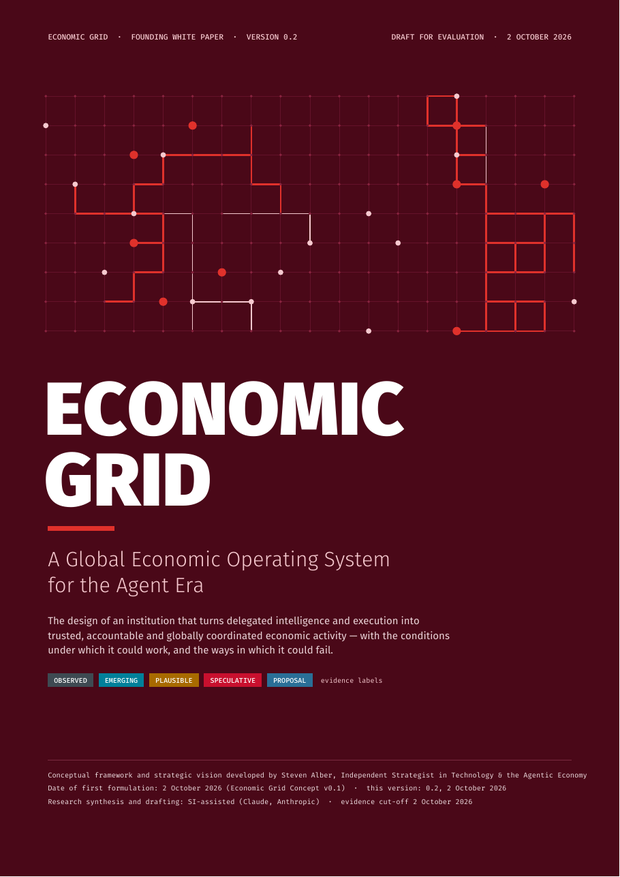
Cover of Economic Grid — A Global Economic Operating System for the Agent Era, version 0.2

White paper · version 0.2

Economic Grid — A Global Economic Operating System for the Agent Era

Version
0.2 · draft for evaluation
Date
2 October 2026
Length
74 pages · 19 sections · 8 diagrams
Format
PDF · 0.4 MB

The founding design: the mature system first, then what would have to become true for it to work. It defines the accountable mandate, a twelve-component architecture, temporary enterprises with persistent obligations, a capital system, liability institutions, governance and illustrative economics — and states plainly where the design could fail.

Every consequential claim carries an evidence label: observed, emerging, plausible, speculative — or proposal, for design choices. Appendix A records which earlier claims were rechecked and which were not.
13Participation

Every participant has a path

Businesses register for early access. Developers, researchers, capital partners and infrastructure providers register to build, test, finance and operate parts of the grid.

Businesses

Register for early access. Your registration is time-stamped, and the needs you describe help decide which workflows are built first.

Register your company →

Developers

Build agents, verifiers and integrations against the mandate and obligation model as the protocol specification takes shape.

Register as a developer →

Researchers

Challenge the white paper. Its research agenda lists fourteen open questions — legal, technical and economic — that need independent work.

Register as a researcher →

Capital partners

Licensed lenders, insurers and fund managers interested in underwriting verified obligations as the capital system matures.

Register as a capital partner →

Infrastructure providers

Payment, identity, inspection, logistics and compliance providers interested in operating regulated functions under local law.

Register as an infrastructure provider →